
Hidden Fees in International Money Transfers
Introduction
We send $350 to family. The transfer confirmation shows a $4 fee. We expect them to receive the equivalent of $346. But when they check, the amount in local currency is noticeably less than that calculation would suggest.
Where did the rest go?
This is one of the most common and least explained experiences in international money transfers. The visible fee is real — but it is not always the only cost. International transfers can involve several layers of pricing, some clearly disclosed and some embedded in the transaction in ways that are easy to miss.
Understanding what those layers are — and how to account for them when evaluating transfer options — is how we close the gap between what we send and what our family actually receives.
Visible Fees vs. Hidden Costs
Before exploring the different types of transfer costs, it helps to understand the distinction between what is clearly shown and what is not.
Visible fees are the charges a transfer service displays upfront — typically before we confirm the transaction. A service might show “$3 transfer fee” or “2% service charge” as a line item in the transfer summary. These fees are real costs, but they are transparent — we can see them, account for them, and compare them between services.
Hidden costs are not necessarily dishonest — they are not always labeled as fees, but they still reduce the amount the recipient receives. They appear through exchange rate margins, payment method surcharges, intermediary bank processing charges, and delivery method pricing differences.
The practical result of these additional costs is captured in a simple relationship:
Received amount = Sent amount − Total transfer costs
The challenge is that “total transfer costs” includes more than the visible fee. When we evaluate a transfer based on the advertised fee alone, we may be significantly underestimating its true cost.
The Exchange Rate Margin: The Largest Hidden Cost
Of all the ways transfer costs can be obscured, the exchange rate margin is consistently the most significant — and the least visible.
As we explain in our guide How Exchange Rates Affect International Transfers, every international transfer involving different currencies requires a conversion. The price of that conversion — the exchange rate — determines how many units of local currency the recipient receives per dollar sent.
Global financial markets produce a mid-market rate — the true midpoint between currency buying and selling prices, the rate that major banks use when trading currencies with each other. This is the rate shown on financial data websites and currency converter apps.
Most transfer services do not offer customers this rate. They offer a slightly less favorable rate and keep the difference. This gap — the exchange rate margin — functions as an additional fee, but one that is rarely labeled as such.
A service advertising zero transfer fees may still apply a 3% to 5% exchange rate margin — meaning every dollar sent is converted at a rate that delivers 3% to 5% less local currency than the true market rate would produce. On a $400 transfer with a 3% margin, the recipient receives the equivalent of $388 worth of local currency, not $400 — with no fee shown anywhere on the transfer confirmation.
Services that charge explicit, transparent fees but apply exchange rates closer to the mid-market rate may deliver more to the recipient overall than services advertising zero fees but embedding their revenue in the conversion. The only way to evaluate this accurately is to compare the final amount the recipient will receive across services — a figure that incorporates both the visible fee and the exchange rate used.
Payment Method Surcharges
The method we use to fund a transfer is another source of cost variation that is not always prominently disclosed.
Most transfer services accept multiple funding methods — bank account transfers, debit cards, and credit cards. The cost structure varies between them.
Bank account funding is typically the lowest-cost option. The transfer service can process a bank-funded transfer with lower processing costs, and this is usually reflected in lower fees or better exchange rates for bank-funded transactions.
Debit card funding may add a small surcharge on some platforms — sometimes 0.5% to 1% of the transfer amount — because card processing involves network fees that the transfer service passes through to the customer.
Credit card funding consistently generates the highest transfer costs and deserves particular caution. Transfer services typically charge meaningfully higher fees for credit card-funded transfers — sometimes 3% to 5% above the standard fee. Additionally, the credit card issuer may classify the international transfer as a cash advance rather than a standard purchase. Cash advances carry their own higher interest rate — often 25% to 30% APR — applied from the moment of the transaction, not from the statement due date. This combination of transfer service surcharge and credit card cash advance interest can make credit card-funded transfers significantly more expensive than they first appear.
When evaluating the total cost of a transfer, the funding method is a variable worth checking explicitly — particularly if a platform offers different pricing tiers based on how the transfer is funded.
Intermediary Bank Fees
For transfers processed through the traditional banking system — particularly international wire transfers initiated directly from a U.S. bank account — a cost structure known as intermediary bank fees can reduce the amount delivered to the recipient.
When two banks in different countries do not have a direct relationship with each other, an international transfer between them may route through one or more correspondent banks — financial institutions that act as intermediaries in the international payment network. Each correspondent bank involved in processing the transfer may deduct a processing fee before passing the remaining funds to the next institution in the chain.
This fee deduction happens after the transfer has been initiated and the sending bank’s fee has already been paid. The sender may not know in advance how many correspondent banks are involved or what fees they will apply. The result is that the recipient receives less than the transfer amount minus the disclosed wire fee — sometimes significantly less for transfers to certain regions or through certain banking corridors.
This intermediary fee issue is more common with direct bank wire transfers than with dedicated remittance platforms, which typically use specialized payment networks designed to avoid multiple correspondent bank hops. Dedicated transfer services — covered in our guide Best Money Transfer Apps for Immigrants — often route transfers more directly, reducing or eliminating this source of cost.
Delivery Method Cost Differences
How the recipient receives the funds can also affect the pricing structure applied by transfer services.
Bank account deposits are typically the standard delivery method for digital transfer platforms and often carry the most competitive pricing — the service’s standard fee and exchange rate apply without adjustment.
Cash pickup services may involve different pricing. The infrastructure required to operate a physical cash distribution network — agent location agreements, cash float management, compliance costs — is more expensive to maintain than digital bank deposit infrastructure. Some services reflect these higher operational costs in the exchange rate applied to cash pickup transfers, meaning the recipient collects slightly less local currency per dollar sent compared to a bank deposit of the same amount.
Mobile wallet transfers pricing varies by platform and destination. In some corridors, mobile wallet delivery is priced similarly to bank deposits. In others, there may be differences reflecting the specific mobile payment network partnerships involved.
For senders whose recipients have access to both bank accounts and cash pickup locations, comparing the final received amount across delivery methods — not just between services — sometimes reveals meaningful differences worth considering.
Recurring Transfer Costs and Their Annual Impact
For immigrants who send money regularly — monthly or more frequently — the cumulative effect of transfer costs compounds into a significant annual figure.
Consider a sender transferring $300 monthly. If the true all-in cost of each transfer — explicit fee plus exchange rate margin — represents 4% of the sent amount, the total annual cost of remittances is approximately $144. If a different service or approach reduces the effective cost to 2%, the annual cost drops to approximately $72 — a difference of $72 per year, representing funds that either stay with the sender or reach the recipient rather than being absorbed by transfer costs.
Across a decade of monthly transfers, the difference between a 2% and 4% all-in transfer cost on $300 monthly is approximately $720 — equivalent to two and a half months of transfers.
This cumulative perspective explains why the effort of comparing services based on final received amounts — rather than simply using a familiar service without revisiting the choice — has real financial value for regular senders. We cover practical comparison strategies in our guides Cheapest Ways to Send Money Abroad and Wise vs Remitly vs Western Union: Which Is Best?
Regulatory Disclosure Requirements
It is worth noting that U.S. regulations do require money transfer services to disclose certain costs before a transfer is confirmed.
The Remittance Transfer Rule — established under the Dodd-Frank Act and implemented by the Consumer Financial Protection Bureau (CFPB) — requires covered remittance transfer providers to disclose the exchange rate applied, all fees and taxes charged, and the amount the recipient will receive, before the sender confirms the transaction.
This regulation has improved transparency meaningfully for consumers using covered services. However, not all transfer services are covered by this rule under all circumstances — and the disclosed amounts may still not fully convey the exchange rate margin in terms that are easy to compare.
The most reliable consumer protection remains the practice of comparing the final disclosed received amount across services before confirming any significant transfer — using that number, rather than the advertised fee alone, as the primary basis for decision-making.
How to Minimize Hidden Costs in Practice
Understanding the sources of hidden transfer costs points directly to the practices that reduce them.
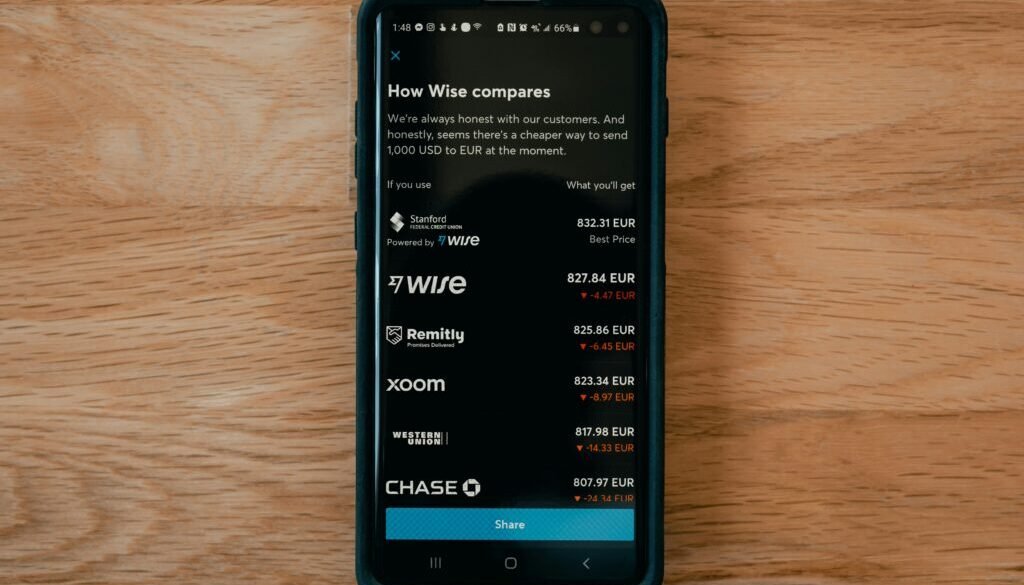
Always compare final received amounts. Before confirming a transfer, check the same amount to the same destination through at least one alternative service. The final received amount comparison captures all cost components — fee, exchange rate margin, and any payment method adjustments — in one number.
Use bank account funding when possible. Avoiding credit card funding eliminates cash advance interest risk and typically reduces the service-level fee as well.
Check the exchange rate against the mid-market rate. A financial data website or currency app shows the current mid-market rate. Comparing this to the rate offered by a transfer service reveals the margin being applied — information that the fee disclosure alone does not provide.
Use dedicated remittance platforms for regular transfers. Platforms built specifically for international money transfers — rather than standard bank wire services — typically offer more competitive exchange rates and avoid intermediary bank fees through more direct payment routing.
Review the service periodically. Transfer service pricing changes over time. A service that offered the best value twelve months ago may no longer do so. A brief comparison every few months keeps costs current.
Conclusion
International money transfers rarely involve a single, simple cost. The visible transfer fee is real — but exchange rate margins, payment method surcharges, intermediary bank charges, and delivery method differences can all reduce the amount that reaches the recipient, often without a clear label explaining where the value went.
Understanding these cost layers does not eliminate them — but it transforms our ability to evaluate transfer options accurately. When we know that the final received amount is the only number that captures everything, and we make that comparison a habit before each significant transfer, we keep more of our money where it belongs.
MARVODYN provides financial education for informational purposes only. Transfer costs vary depending on transfer providers, destination countries, payment methods, and currency exchange rates. This content does not constitute remittance services or financial advice. See our full disclaimer at marvodyn.com.