Online Banks vs Traditional Banks: Which Is Better?
Introduction
When we begin looking for a bank account in the United States, we quickly discover that not all banks work the same way.
Some banks have physical branch locations on street corners, inside shopping centers, and in neighborhoods across the country. Others exist almost entirely online — accessible through a website or a mobile app, with no physical office to visit.
For immigrants who are new to the U.S. financial system, this distinction matters. The type of bank we choose affects how we access our money, how we resolve problems, what fees we pay, and how convenient our daily banking experience will be.
Neither option is universally better. Each has genuine advantages and real limitations. The right choice depends on how we plan to use our account and what kind of banking experience suits our lifestyle.
This guide explains both models clearly so we can make that decision with confidence.
What Are Traditional Banks?
Traditional banks — sometimes called brick-and-mortar banks — are financial institutions that maintain physical branch locations. We can walk into a branch, speak with a bank employee, open an account, deposit money, withdraw cash, or resolve account issues face to face.
In the United States, traditional banks range from large national institutions with thousands of branches across the country to smaller regional banks serving specific states or communities. Many of the most recognizable bank names — institutions that have operated for decades — fall into this category.
Traditional banks also typically maintain extensive ATM networks. As customers, we can withdraw cash from these ATMs without paying fees, as long as we stay within the bank’s own network.
These institutions offer a full range of financial services — checking accounts, savings accounts, loans, mortgages, credit cards, and investment products — all available through a combination of in-person service and digital platforms.
For a deeper look at specific institutions that are commonly accessible to immigrants, our guide Best Banks for Immigrants in the United States provides a balanced overview.
Advantages of Traditional Banks
Traditional banks offer several benefits that are particularly relevant for immigrants navigating a new financial system.
In-person customer support. When something goes wrong — an unrecognized transaction, a question about our account, a document we need — being able to walk into a branch and speak with someone directly is a significant advantage. For people who are still learning financial terminology in a new language, or who simply feel more comfortable handling important matters in person, this access is genuinely valuable.
Easier cash deposits. Traditional banks make it straightforward to deposit physical cash into our account, either through a teller at a branch or through ATMs that accept cash deposits. This matters more than it might seem — particularly for immigrants who receive cash income or who are still transitioning away from cash-based financial habits.
Broad ATM networks. Large national banks often maintain thousands of ATMs across the country. For customers who use cash regularly, having free ATM access in many locations is a practical benefit.
Established reputation and familiarity. Traditional banks have often operated for many decades. For people who are cautious about where they keep their money, the familiarity and visible presence of a traditional bank can provide a sense of reassurance.
Access to a wide range of services in one place. Traditional banks often offer more financial products than online-only institutions — including personal loans, mortgages, and in-person financial guidance. As our financial needs grow over time, having access to these services through an institution we already have a relationship with can be convenient.
Limitations of Traditional Banks
Traditional banks also come with trade-offs that are worth understanding before we commit.
Higher fees. Operating physical branch locations is expensive. Traditional banks cover these costs partly through account fees — monthly maintenance fees, minimum balance fees, and various service charges. While many accounts offer ways to waive monthly fees, the conditions for doing so may not always be easy to meet, particularly for immigrants who are just getting established financially.
Minimum balance requirements. Some traditional bank accounts require us to keep a minimum balance at all times to avoid fees. For someone who is still building financial stability, having money locked into a minimum balance requirement can feel restrictive.
Lower interest rates on savings. Because traditional banks have higher operating costs, they typically offer lower interest rates on savings accounts than online banks. This means our savings grow more slowly when held at a traditional bank compared to some digital alternatives.
We explore how to evaluate and avoid unnecessary banking fees in our guide How to Avoid Bank Fees in the U.S.
What Are Online Banks?
Online banks are financial institutions that operate primarily — or entirely — through digital platforms. There are no physical branch locations to visit. We manage our account through a mobile app on our phone or through a website on our computer.
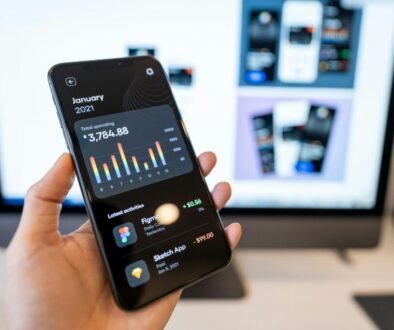
Online banks offer many of the same core services as traditional banks: checking accounts, savings accounts, money transfers, and debit cards. Most have strong mobile apps that allow us to check balances, pay bills, transfer money, and deposit checks by taking a photo — all from our phone.
Because online banks do not carry the cost of maintaining physical branches and large staff, their operating expenses are lower. Many pass these savings directly to customers through reduced fees and better interest rates on savings accounts.
Some of the most well-known online banks in the United States have grown significantly in recent years as digital banking has become more widely used and trusted.
Advantages of Online Banks
Online banks offer a distinct set of benefits that appeal particularly to people who are comfortable managing finances digitally.
Lower or no monthly fees. This is one of the most significant advantages. Many online bank accounts charge no monthly maintenance fees at all — regardless of our balance or how we use the account. For immigrants who are watching every dollar as they establish themselves financially, this difference matters.
Higher interest rates on savings accounts. Because online banks have lower operating costs, they can afford to offer higher annual percentage yields on savings accounts. Over time, this means our savings grow faster. For someone who is actively building an emergency fund or working toward a financial goal, this is a meaningful benefit.
Convenient digital tools. Online banks typically invest heavily in their mobile apps, because the app is the primary way their customers interact with the bank. Features like mobile check deposit, instant payment notifications, easy transfers, and clear spending summaries are standard. For people who manage most of their life through a smartphone, this experience can feel more intuitive than visiting a branch.
Simple account opening process. Many online banks allow account opening to be completed entirely through a mobile app or website. For some immigrants, this is more accessible than arranging an in-person branch visit with documentation.
ATM fee reimbursement. While online banks do not have their own ATM networks, many reimburse fees charged by third-party ATMs up to a certain amount per month. This means we can often use any ATM without paying out-of-pocket fees, as long as we stay within the reimbursement limit.
Limitations of Online Banks
Online banks also have real limitations that may matter depending on our circumstances.
No physical branches. If we prefer in-person assistance, an online bank cannot provide it. All customer support happens through phone, online chat, or email. For someone who is still adjusting to financial systems in a new language, or who simply prefers face-to-face communication for important matters, this can be a genuine drawback.
Difficulty depositing cash. This is one of the most significant practical limitations of online banks. Because there are no branches and most online banks do not have their own ATMs that accept deposits, adding physical cash to our account can be complicated or impossible with some providers. People who regularly deal with cash — whether from work or daily habits — may find this frustrating.
No in-person problem resolution. When something goes wrong — a disputed transaction, an account access issue, an unusual hold on our funds — online banks handle these situations remotely. Response times and the quality of support vary between institutions. For complex issues, the absence of a branch to visit can make resolution feel slower.
Identity verification requirements. Some online banks require a Social Security Number for account opening and may have stricter digital identity verification processes. For immigrants who do not yet have an SSN and are relying on an ITIN and passport for identification, certain online banks may not be accessible. We explain this in more detail in our guides Can You Open a Bank Account Without a Social Security Number? and ITIN vs SSN for Opening a Bank Account.
Deposit Insurance
Regardless of whether we choose an online bank or a traditional bank, our money should be protected by federal deposit insurance — provided we choose a federally insured institution.
Most traditional banks are insured by the Federal Deposit Insurance Corporation (FDIC). Many online banks are also FDIC-insured, either directly or through a partner bank relationship. Credit unions — whether traditional or digital — are typically insured by the National Credit Union Administration (NCUA).
This insurance protects our deposits up to a specified limit per depositor per institution. If the bank were to fail, our money is protected. We should always confirm that any bank we consider is federally insured before opening an account.
How to Decide Which Is Right for Us
There is no single correct answer. The better choice depends on how we plan to use our account and what matters most to us.
Consider a traditional bank if: We value in-person customer support, especially while we are still learning to navigate the U.S. financial system. We regularly handle physical cash and need a convenient way to deposit it. We prefer having a branch nearby for account opening or for resolving problems. We are less comfortable managing finances entirely through a mobile app.
Consider an online bank if: We are comfortable managing our finances digitally through a smartphone or computer. Keeping monthly fees as low as possible is a priority. We want a higher interest rate on our savings. We rarely deal with physical cash and do not need in-person banking services.
Consider using both: Some people use a traditional bank account for cash deposits and in-person needs, alongside a high-yield online savings account for money they are setting aside. This hybrid approach takes advantage of the strengths of both models simultaneously.
Understanding our own financial habits — how we receive income, whether we use cash, how comfortable we are with digital tools, and what level of customer support we need — is the foundation of this decision.
Our guide How to Choose Your First Bank Account in the U.S. walks through these factors in detail and helps us evaluate options based on our specific situation. And our guide Checking vs Savings Accounts: What’s the Difference? explains how the two main account types work within either banking model.
Conclusion
Online banks and traditional banks are both safe, legitimate ways to manage money in the United States. They are not competing for the title of best — they are simply different tools designed for different preferences and lifestyles.
Traditional banks offer physical presence, cash handling, and in-person support. Online banks offer lower fees, better savings rates, and a streamlined digital experience. Neither is superior in absolute terms.
What matters is which model fits how we actually live and manage our finances — and that is a question only we can answer.
Once we understand how both types of banks work, the decision becomes much simpler. We choose the account that removes friction from our daily financial life, keeps our costs manageable, and gives us the tools we need to build financial stability here.
MARVODYN provides financial education for informational purposes only. This content is not financial advice. Banking services, fees, interest rates, and account features vary between institutions and may change over time. Please verify all information directly with financial institutions before making decisions. See our full disclaimer at marvodyn.com.